


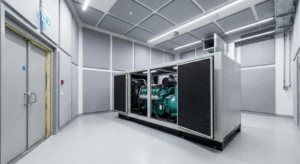
Generator sets are essential infrastructure across Oman’s industrial, commercial, and institutional facilities, providing backup power for hospitals, data centers, telecommunications, and manufacturing operations. However, these critical systems generate substantial noise that can exceed 100 dB at close proximity, creating serious occupational health hazards and environmental compliance challenges. Comprehensive acoustic design transforms generator rooms from noise hazards into well-controlled spaces, protecting personnel while meeting regulatory requirements.
Understanding Generator Noise Characteristics
Generator sets produce complex noise encompassing multiple frequency ranges and transmission paths. Low-frequency rumble from engine combustion (63-250 Hz) transmits readily through structures and is difficult to attenuate. Mid-frequency mechanical noise from alternator and auxiliary components (250-2000 Hz) dominates overall sound pressure levels. High-frequency cooling fan and exhaust noise (2000-8000 Hz) is directional and easier to control, but still significant.
Noise transmits through three primary paths requiring different control strategies: airborne transmission through walls, doors, and ventilation openings; structure-borne vibration through equipment mounting and building connections; and ducted paths through intake, exhaust, and cooling systems. Comprehensive solutions address all three simultaneously.
The specific challenge in Oman involves balancing acoustic control with massive ventilation requirements. Generator sets in tropical climates require substantial cooling airflow—often 100+ air changes per hour—creating natural paths for noise escape. Acoustic design must provide this ventilation while maintaining sound attenuation.
Regulatory Framework and Performance Targets
Oman’s occupational safety regulations limit worker noise exposure to 85 dB over 8-hour periods, with higher short-term exposures permitted only with hearing protection and administrative controls. However, engineering controls reducing noise at the source must be implemented before relying on personal protective equipment.
For generator rooms, this typically translates to interior design targets of 85-90 dB during operation, with exterior levels depending on proximity to occupied areas. Rooms adjacent to offices should achieve 45-50 dB, while industrial areas may permit higher levels. Environmental regulations may impose community noise limits at property boundaries.
PET Acoustic Panels and other absorption materials help achieve these targets by reducing reverberant buildup inside generator rooms, lowering overall sound pressure levels experienced by maintenance personnel, and improving acoustic performance of barriers and enclosures by eliminating reflected energy.
Acoustic Barrier Design for Generator Rooms
Effective generator room construction employs mass, isolation, and absorption. Wall assemblies typically include dense concrete or masonry providing mass to block sound transmission, vibration-isolated construction preventing structure-borne transmission, internal absorption controlling reverberant buildup, and sealed construction eliminating flanking paths.
Concrete walls 200-300mm thick provide baseline acoustic performance, with thicker construction required for the most demanding applications. Block walls must be fully grouted and plastered to eliminate air paths. Double-wythe construction with isolation between layers achieves superior performance for critical installations.
Door and access penetrations represent the weakest acoustic links. Acoustic-rated doors with proper seals, double-door airlocks for frequently accessed rooms, and minimized number and size of openings maintain barrier integrity. A single poorly sealed door can negate an otherwise excellent acoustic design.
Windows should be avoided in generator rooms. When observation is necessary, small double-glazed windows with laminated glass and substantial separation between panes provide visual access while limiting acoustic compromise.
Ventilation Acoustic Design
Generator room ventilation creates the most challenging acoustic design aspect. Large openings for cooling airflow naturally transmit noise unless properly treated. Effective strategies include acoustic louvers with internal baffles providing attenuation while allowing airflow, extended acoustic plenums creating indirect sound paths with absorption, and silencer sections in large ventilation ducts.
Acoustic louvers typically achieve 15-25 dB insertion loss across critical frequencies while maintaining acceptable air velocity and pressure drop. Multiple louver stages or combination with other treatments achieves greater attenuation for demanding applications.
Ventilation air should enter and exit through opposite walls to prevent short-circuiting while maximizing equipment cooling. Supply and exhaust openings located to direct noise away from sensitive areas minimize environmental impact.
Sound absorbing panels installed in ventilation plenums and ductwork absorb sound energy before it exits the facility. Mineral wool or fiberglass materials withstand the temperature and velocity conditions in generator ventilation systems while providing excellent absorption, particularly when protected by perforated metal facings.
Vibration Isolation Strategies
Generator sets create substantial vibration transmitted through mounting systems into building structures. This structure-borne noise can radiate throughout facilities, affecting distant spaces unexpectedly. Comprehensive vibration isolation prevents these problems.
Spring or elastomeric isolators under generator sets block vibration transmission to floors. Isolated inertia bases provide additional mass and stability for critical applications. Flexible connections in all piping, electrical conduit, and exhaust systems prevent vibration bypass around isolators.
In multi-story buildings, generator rooms should be located on ground floors or basements to minimize structure-borne transmission to occupied spaces. When upper-level installation is unavoidable, floating floor systems provide additional isolation between equipment and the primary structure.
Exhaust System Acoustic Treatment
Generator exhaust systems require specialized acoustic treatment, managing extremely high temperatures and pressures while providing substantial noise reduction. Industrial-grade reactive mufflers designed for diesel exhaust, critical-grade silencers for maximum attenuation in sensitive applications, and flexible exhaust connections preventing vibration transmission comprise comprehensive systems.
Exhaust silencers can achieve 25-40 dB noise reduction across broad frequency ranges. Multiple mufflers in series provide greater attenuation when necessary. Proper sizing prevents excessive backpressure that degrades generator performance or causes premature failure.
Exhaust discharge points should be located away from air intakes, pedestrian areas, and noise-sensitive spaces. Vertical discharge above roof level disperses noise and prevents ground-level concentrations.
Monitoring and Maintenance
Even well-designed acoustic systems require monitoring and maintenance. Acoustic testing verifies as-built performance meets design targets, identifies deficiencies requiring correction, and establishes baseline for future comparisons. Periodic noise monitoring detects degradation from seal failures, deteriorating absorption materials, and equipment changes. Regular maintenance of doors, seals, louvers, and acoustic materials ensures continued performance.
Akinco Oman provides turnkey generator room acoustic solutions from initial assessment through final testing and commissioning, ensuring comprehensive noise control that protects personnel while maintaining regulatory compliance across industrial, commercial, and institutional applications throughout the Sultanate.
FAQs
- What noise reduction can be achieved in generator rooms?
Well-designed generator rooms typically achieve 30-50 dB noise reduction from interior to exterior, depending on wall construction, door design, and ventilation treatment. Interior reverberation control can reduce sound pressure levels by 5-10 dB, directly benefiting maintenance personnel.
- How much ventilation do generator rooms require in Oman’s climate?
Tropical climate generator installations typically require 60-150 air changes per hour depending on generator size and room volume. Exact requirements should be calculated based on manufacturer heat rejection data and allowable temperature rise. Undersizing ventilation causes overheating and premature failure.
- Can existing generator rooms be acoustically upgraded?
Yes, most generator rooms can be retrofitted with acoustic absorption, upgraded doors and seals, acoustic louvers on ventilation openings, and vibration isolation. However, upgrades are more expensive and less effective than incorporating acoustic design initially. Professional assessment identifies cost-effective improvements.
- What acoustic materials withstand generator room conditions?
Materials must tolerate heat, vibration, oil vapor, and dust. Mineral wool, high-temperature fiberglass with appropriate facings, PET panels in lower-temperature zones, and mass-loaded vinyl barriers perform reliably. Natural fibers and foam materials should be avoided due to flammability and degradation concerns.
- How often should generator room acoustic systems be inspected?
Annual inspections verify acoustic seal integrity, check absorption material condition, and test door operation. Following generator maintenance involving exhaust work or structural modifications, acoustic testing should verify continued performance. Address any deterioration promptly to prevent progressive degradation.
