


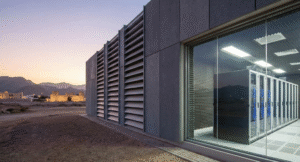
Muscat’s emergence as a regional digital hub is driving significant data center development, from enterprise facilities to carrier-neutral colocation providers and cloud service edge locations. These mission-critical facilities face unique acoustic challenges, balancing massive cooling requirements with noise control for equipment protection and personnel safety. Understanding data center acoustic design principles ensures reliable operations while maintaining safe, compliant work environments.
Data Center Noise Sources and Characteristics
Modern data centers generate substantial broadband noise from cooling infrastructure. Computer Room Air Conditioning (CRAC) units produce 75-85 dB from fans, compressors, and airflow. Precision cooling systems add 70-80 dB of constant operation noise. Server equipment itself contributes 60-70 dB from countless small cooling fans operating simultaneously.
In Oman’s climate, cooling loads exceed global averages, facilities may require 1.5-2.0 kW of cooling capacity per kW of IT load. This translates to larger, more numerous cooling units and correspondingly higher noise levels. A medium-sized data center can easily generate interior sound pressure levels exceeding 85 dB, creating occupational health concerns for technical staff.
Low-frequency noise dominates data center acoustic environments. Compressor and large fan noise concentrates in 63-250 Hz octave bands, which readily transmit through structures and are difficult to attenuate. This low-frequency energy can affect adjacent spaces, including offices, causing distraction and discomfort even when higher frequencies are controlled.
Personnel Protection and Regulatory Compliance
Oman’s occupational health regulations mandate hearing conservation programs when 8-hour time-weighted average exposures exceed 85 dB. Data center operators must implement engineering controls, administrative measures, and personal protective equipment as necessary to protect workers.
Technical staff regularly spend hours in data centers performing maintenance, installations, and troubleshooting. Without adequate acoustic control, these exposures can exceed regulatory limits, requiring formal hearing conservation programs with audiometric testing, training, and mandatory hearing protection use.
Engineering noise control through architectural and mechanical design represents the preferred solution, eliminating hazards at the source rather than relying on personal protective equipment. Comprehensive acoustic design reduces noise exposure while improving communication, reducing fatigue, and enhancing work quality.
Acoustic Design Panels strategically placed in data centers reduce reverberant noise buildup, lower overall sound pressure levels, and improve speech intelligibility for personnel communication and emergency response.
Equipment Protection Through Noise Control
While data center equipment is designed for high-noise environments, excessive vibration and acoustic energy can affect sensitive components. Hard disk drives are particularly susceptible to acoustic-induced vibration, affecting read-write head performance and potentially causing data errors or hardware failures.
Research demonstrates that sound pressure levels above 110 dB can cause hard drive performance degradation or failure. While typical data centers don’t reach these extremes, localized hot spots near large cooling units or UPS systems may approach concerning levels. Acoustic design eliminating these peaks protects equipment investments.
Solid-state storage is less acoustically sensitive, but the broader trend toward acoustic management supports equipment longevity and reliability across all components by reducing vibration stress and maintaining optimal environmental conditions.
Cooling Efficiency and Acoustic Performance
The fundamental challenge in data center acoustic design involves maintaining massive airflow requirements while providing noise control. Restrictions on airflow increase pressure drop, requiring larger fans operating at higher speeds, which generates more noise while consuming more energy.
Successful designs balance these competing requirements through low-velocity airflow design minimizing turbulence noise, strategic equipment placement isolating high-noise sources, acoustic absorption controlling reverberant buildup without blocking airflow, and targeted barriers protecting occupied areas without restricting cooling.
Sound-absorbing panels with appropriate air permeability allow acoustic treatment in active cooling airflow paths. Suspended baffles, wall-mounted panels with standoffs, and ceiling treatments reduce reverberation while minimizing impact on computational fluid dynamics essential for cooling optimization.
Hot aisle/cold aisle containment strategies inherently support acoustic design by segregating high-velocity cooling airflow from occupied maintenance aisles. This separation enables acoustic treatment in cold aisles where personnel work while maintaining unrestricted flow in hot aisles.
Architectural Acoustic Considerations
Data center room construction significantly affects acoustic performance. Massive walls provide sound isolation from adjacent spaces while dense construction prevents resonance that amplifies low-frequency noise. Suspended acoustic ceiling systems appropriate for data center environments absorb high-frequency energy while allowing cable distribution and cooling airflow.
Ceiling systems must be carefully specified; standard acoustic tiles suitable for offices may fail in data center environments due to excessive weight, high humidity, or particulate accumulation. Purpose-designed products withstand data center conditions while providing acoustic benefits.
Raised floor systems, common in data centers, create large plenum spaces that can propagate noise throughout facilities. Acoustic treatment of underfloor surfaces controls this transmission. However, materials must not shed particles that could contaminate IT equipment or block airflow distribution.
Equipment Selection and Specification
Proactive noise control begins with equipment selection. Manufacturers increasingly offer low-noise cooling options, recognizing acoustic concerns. Variable speed drives allow cooling capacity matching to instantaneous loads, reducing fan speeds and noise during periods of lower heat generation.
Specifying maximum noise levels in equipment procurement ensures vendors provide appropriate solutions. Sound power level specifications (expressed in dB relative to 1 picowatt) enable accurate acoustic modeling during design. Field verification testing confirms as-built performance meets specifications.
Equipment placement dramatically affects acoustic outcomes. Locating high-noise cooling units away from primary maintenance areas, using equipment rooms with enhanced acoustic isolation for central chillers and air handlers, and strategic orientation directing noise away from occupied spaces all reduce exposure without restricting functionality.
Design Integration and Optimization
Successful data center acoustic design requires early integration with mechanical, electrical, and architectural disciplines. Akinco Oman provides collaborative acoustic consulting throughout design development, ensuring acoustic objectives align with cooling efficiency, power distribution, equipment access, and budget constraints.
Acoustic modeling during design identifies potential problems enabling correction before construction. Post-construction acoustic testing verifies performance and identifies any deficiencies requiring remediation. This comprehensive approach ensures data centers provide safe, compliant work environments supporting Muscat’s growing digital infrastructure needs.
FAQs
- What noise levels are typical in Muscat data centers?
Without acoustic treatment, data centers commonly experience 80-95 dB interior sound pressure levels. Well-designed acoustic solutions can reduce this to 75-85 dB while maintaining cooling efficiency. Specific levels depend on equipment density, cooling architecture, and room volume.
- How does acoustic treatment affect data center cooling efficiency?
Properly designed acoustic treatments have minimal impact on cooling efficiency. Low-velocity airflow design, permeable acoustic materials, and strategic placement maintain airflow patterns while providing noise control. Poorly designed systems restricting airflow can increase energy consumption by 10-20%.
- What acoustic materials are appropriate for data center environments?
Materials must resist humidity, not shed particles, withstand moderate temperatures, and provide flame resistance. PET panels, mineral wool with appropriate facings, and specialized metal panel systems perform reliably. Standard fiberglass tiles should be avoided due to particle shedding concerns.
- Can existing data centers be acoustically treated?
Yes, most facilities can be retrofitted with ceiling-mounted baffles or panels, wall treatments in maintenance areas, and equipment enclosures for high-noise sources. Retrofits cost more and achieve less noise reduction than integrated design, but provide meaningful improvements for occupational health compliance.
- What acoustic design considerations apply to modular data centers?
Modular facilities require a comprehensive acoustic design addressing both interior noise control for personnel and exterior noise emissions affecting adjacent properties. Factory integration of acoustic treatments during module fabrication typically provides better performance and lower cost than field installation.
